

SPY vs QQQ for 0DTE: Liquidity, Volatility and Gamma
SPY and QQQ trade almost the same way in 0DTE, but not with the same risk profile: SPY is calmer and easier to execute, while QQQ moves more and amplifies both gains and losses.
This article compares the two on the five criteria that really matter for a same-day options trader:
- liquidity and spreads, which set the real cost of getting in and out;
- volatility, which determines the size of the moves and how fast time value decays;
- market maker behavior, whose hedging influences intraday price levels;
- expiration hours and rules, including the assignment risk specific to ETF options;
- fit with your style, because the right instrument is the one you know how to read.
This content is educational: it explains market mechanics and is not investment advice.
What you are really trading: S&P 500 vs Nasdaq-100
SPY tracks the S&P 500 and QQQ tracks the Nasdaq-100: the difference in behavior starts with the composition of these two indexes.
According to a comparison published in June 2026 by The Motley Fool, SPY holds about 504 stocks, 39% of them in technology, with 37% of the fund in its top ten holdings. QQQ holds about 102, 59% in technology, with 46% in its top ten. Its five-year beta is 1.23 versus 1.0 for SPY: on average, QQQ amplifies market moves. These figures are orders of magnitude, since the page does not state their calculation date.
On the options side, both share the same rules: they are American-style options (exercisable at any time) with physical settlement (delivery of shares on exercise), on lots of 100 shares, according to Option Alpha. They therefore differ from the SPX index, which is European-style and cash-settled.
Liquidity and spreads: SPY keeps the edge
SPY is the deepest ETF options market, and its spreads are generally tighter than QQQ's, even though QQQ remains very liquid.
According to ApexVol (ORATS data, 20 sessions to September 25, 2026), SPY trades about 10.5 million contracts per day versus about 7.3 million for QQQ, with about 18.5 million contracts of open interest. On at-the-money options with a near expiration, the bid/ask spread is 1 to 5 cents on SPY and 5 to 15 cents on QQQ. Note: these quotes are for the October 16, 2026 expiration, not 0DTE.
On expiration day itself, spreads widen. Schaeffer's Research measured in September 2023, five minutes before the close, a spread of $0.14 to $0.15 on an at-the-money SPY option expiring that day, about 6.7% of the price, versus about 0.7% for the next expiration. It is a single session, but the direction is clear: the closer expiration gets, the wider market makers quote, because hedging becomes harder.
What matters for a trader is the round-trip cost expressed as a percentage of the premium, not in cents. Three habits limit that cost on both instruments:
- use limit orders rather than market orders;
- avoid opening positions in the last minutes of the session;
- compare the spread to the option price, since the same gap weighs far more on a $0.30 option than on a $3 option.
Volatility: QQQ moves more, so it cuts faster both ways
QQQ is structurally more volatile than SPY, because the Nasdaq-100 is more concentrated in technology and in a small number of mega-caps.
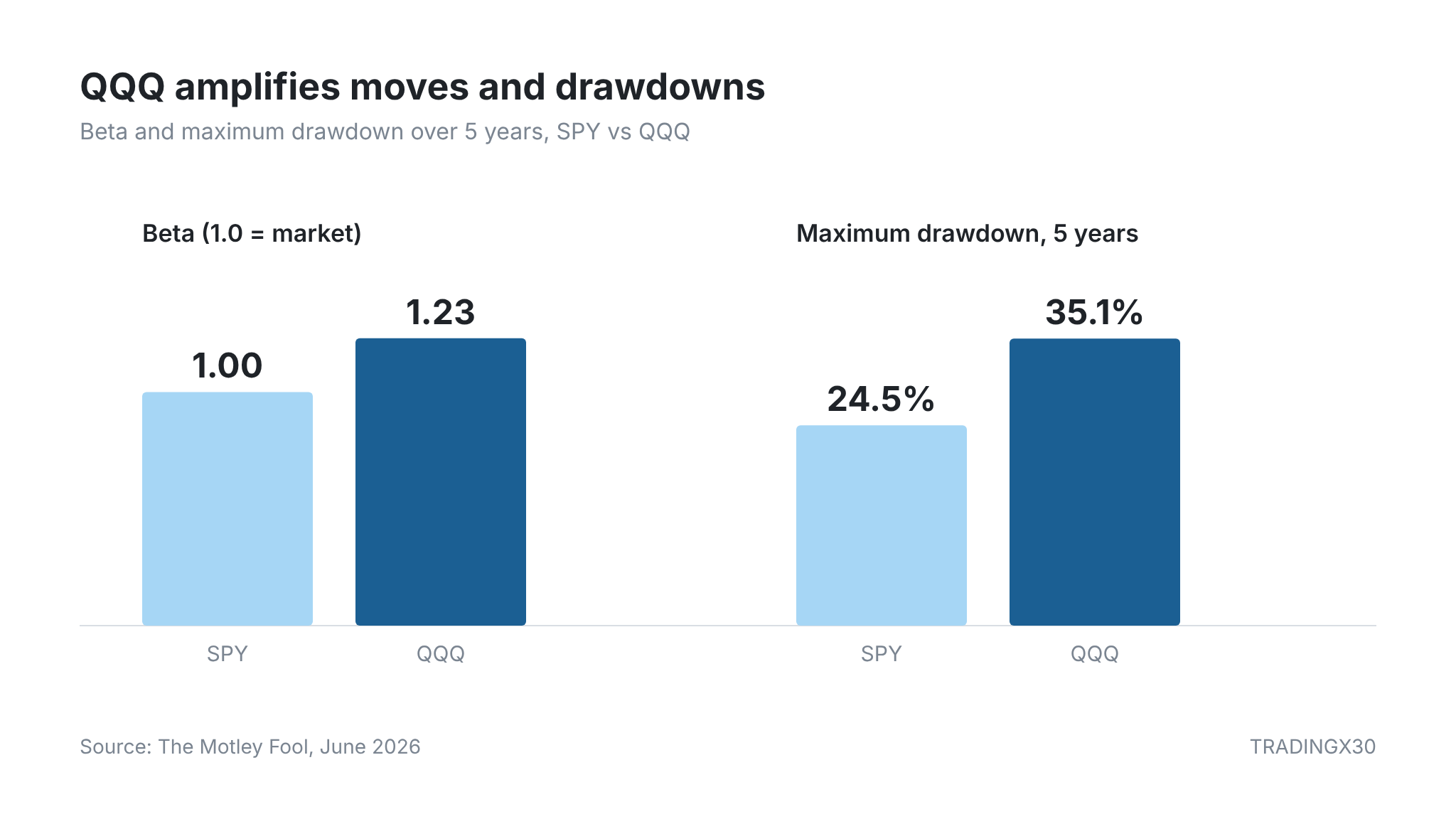
The figures above confirm it: a beta of 1.23 for QQQ versus 1.0 for SPY, and a five-year maximum drawdown of 35.1% versus 24.5% (The Motley Fool). In 0DTE, this translates into three concrete effects:
- Larger moves in percentage terms. The same catalyst (a mega-cap tech earnings report, an inflation print) generally moves QQQ more than SPY.
- Higher premiums. The wider the expected move, the more time value you pay at the open, and the faster theta destroys it.
- Greater gap risk on news. An announcement specific to a Nasdaq-100 stock can move QQQ alone, without SPY following in the same proportion.
The flip side is symmetrical. A winning position gains faster on QQQ, but a losing one also loses faster. With the same number of contracts, the potential loss is not the same: size your position by risk, not by number of contracts.
One last point: implied volatility, which sets option prices, can drop after an announcement. This is the "IV crush": you can be right on direction and still lose. It affects both instruments on catalyst days.
Market makers and gamma: how hedging influences SPY and QQQ
Market makers buy and sell options continuously, but they do not try to bet on direction. They hedge their exposure by buying or selling the underlying. That hedging is the mechanism through which options positioning influences the price of the ETF.
The principle, explained in general terms by data providers such as SpotGamma, comes down to two regimes:
- Positive gamma. Market makers hedge by selling when price rises and buying when it falls. Their flow dampens moves: the market tends to mean-revert better, and supports and resistances are cleaner.
- Negative gamma. They hedge in the same direction as the move: they buy when it rises and sell when it falls. Their flow amplifies the move, which favors accelerations and sharper squeezes.
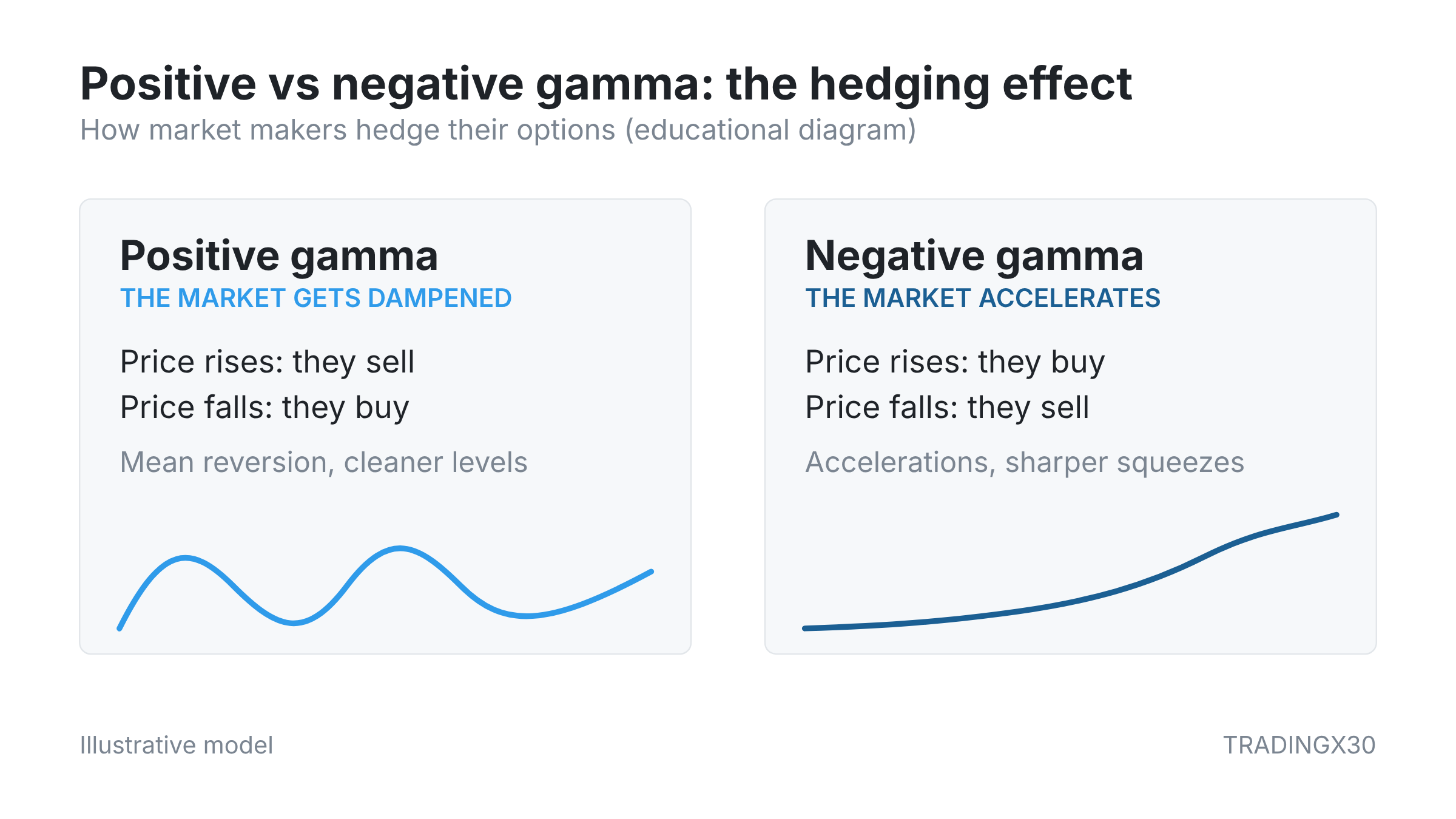
An option's gamma is highest near the money and rises sharply as expiration approaches. In 0DTE, the intensity of these hedge adjustments is therefore at its peak late in the session, hence the sometimes abrupt moves around the most heavily loaded strikes.
What changes between SPY and QQQ
The mechanism is the same for both ETFs, but the useful levels differ. Call walls, put walls and net gamma are read separately for each underlying, with their own strikes. QQQ's higher volatility generally means these levels get tested faster on a catalyst.
Reading guidelines, for educational purposes:
- Identify the gamma regime (positive or negative) before choosing a trading style.
- Locate the call wall and the put wall: they often act as slowdown, magnet or rejection zones.
- Watch price relative to the wall: a rejection, a consolidation or a breakout backed by flow can each happen. We speak in probabilities, never certainties.
- Confirm with options flow and intraday structure (VWAP, volume): when several elements align, the scenario has a better statistical edge, with no guarantee of outcome.
Caution: these levels are estimates computed from open interest and assumptions about market maker positioning. They vary by source and are not directly observable.
Expiration hours and rules: what to check
SPY and QQQ offer daily expirations, Monday through Friday, so you can trade 0DTE every trading day.
Options on these two ETFs are American-style and physically settled: they can be exercised at any time before expiration, and an exercise or assignment results in the delivery of shares. This is the major difference from the SPX index, whose options are European-style and cash-settled.
| Item | SPY / QQQ | SPX |
|---|---|---|
| Style | American | European |
| Settlement | Physical (shares) | Cash |
| Last trade | 4:15 p.m. ET (per Option Alpha) | 4:00 p.m. ET |
Practical considerations:
- Assignment risk. A short option at or in the money on SPY or QQQ can be assigned, sometimes before expiration. This creates a stock position that you have to manage.
- Positions left open. An in-the-money option held to the end can be exercised automatically, with a capital or margin requirement you did not anticipate.
- Multi-leg spreads. Defined-risk structures do not protect against every partial-exercise case; know your broker's rules.
For a trader based in Europe
The US session opens at 9:30 a.m. New York time, which is 3:30 p.m. in Paris in normal times. For a few weeks in spring and autumn, the United States and Europe do not change their clocks on the same dates: the time difference then varies by one hour. Check the local opening time before each session during those periods.
Last-trade times can vary by broker and product. Confirm them directly with your broker before trading late in the session.
SPY vs QQQ comparison table
| Criterion | SPY | QQQ |
|---|---|---|
| Index tracked | S&P 500 (500 large companies, all sectors) | Nasdaq-100 (100 stocks, heavy technology weighting) |
| Beta (Motley Fool) | 1.0 | 1.23 |
| Maximum drawdown over 5 years (Motley Fool) | 24.5% | 35.1% |
| Liquidity and spreads | SPY advantage | Good, slightly less tight |
| Intraday volatility | More moderate | Higher |
| Daily expirations | Yes (Monday to Friday) | Yes (Monday to Friday) |
| Style and settlement | American, physical | American, physical |
| Sensitivity to tech earnings | Moderate | Strong |
The numerical values come from the sources cited at the end of the article and correspond to the dates indicated. The other rows are qualitative assessments to verify against your own broker data.
Which profile for which underlying, and mistakes to avoid
What follows is educational: it is not personalized investment advice.
SPY often suits those who prioritize liquidity, tight spreads and more moderate moves, notably when starting out in 0DTE or for larger positions. QQQ attracts those looking for bigger moves and higher premiums, at the cost of more risk per contract.
Common mistakes:
- Choosing QQQ only for the higher premiums, without adjusting position size to the real risk.
- Ignoring the spread and entering at market instead of with a limit order.
- Trading in the last minutes without measuring gamma acceleration and assignment risk.
- Forgetting physical settlement: holding a short in-the-money option into the close can create a stock position.
- Taking a trade ahead of a catalyst without accounting for IV crush, which can lose money even with the right direction.
- Mixing up the gamma levels of the two ETFs: SPY's walls do not apply to QQQ.
Conclusion
SPY and QQQ are not opposites: they answer different needs. SPY offers liquidity and relative stability, QQQ offers bigger moves and sensitivity to technology. In both cases, position sizing, reading gamma and knowing the expiration rules make the difference, far more than the choice of ticker.
Disclaimer: this article is educational and is neither investment advice nor a recommendation. Options trading, especially 0DTE, carries a high risk of capital loss. I am not a licensed financial advisor; always verify contract specifications and your broker's rules.
Sources
- The Motley Fool, SPY vs QQQ comparison, June 2026
- Option Alpha, 0DTE options list
- ApexVol, ETFs for options trading, ORATS data as of September 25, 2026
- Schaeffer's Research, 0DTE spreads, September 2023
- SpotGamma, general explanations on gamma exposure