

Flow doesn’t lie… but it often misleads you.
Every day, thousands of traders open their options flow screen, see a wave of puts bought at the ask*, and conclude the market is heading lower. Flow doesn't lie: the orders are real and the premiums* were paid. It's the interpretation that so often misleads.
A put that was bought is not necessarily a bearish bet. A call at $0.05 is not necessarily a bullish signal. And a large block of premium is worth little when read out of context: gamma, dark pools, price and intraday structure. Here are the three most common traps, followed by a method for reading flow with a more favorable statistical edge.
Trap #1: mistaking a hedge for a directional bet
Flow shows what was bought, never why. A fund holding $50 million of QQQ may buy puts to protect its portfolio: it isn't betting on a decline, it's insuring against one. If the market rises, it loses the premium and is fine with that.
Clues that separate a hedge from a bearish bet: a longer expiry (several weeks), a strike well below the price, steady size, and repeated orders rather than an aggressive sweep. Conversely, puts near the money, with short expiries, bought at the ask or above, as a sweep* and opening* order, look more like aggressive bearish positioning. It's a probability, never a certainty.
Trap #2: confusing lotto with conviction
An out-of-the-money call at a few cents, expiring the same day, can show impressive volume. Its total premium is still tiny: 500 contracts at $0.05 come to only $2,500. That's a lottery ticket, not an institutional signal.
Premium, not contract count, measures conviction. A block carrying $10 million in premium on a longer expiry weighs far more than a thousand lotto contracts, even if those make more noise on screen. Also check whether the order is really "opening": if open interest rises the next day, the position was truly opened.
Trap #3: reading flow without gamma or dark pools
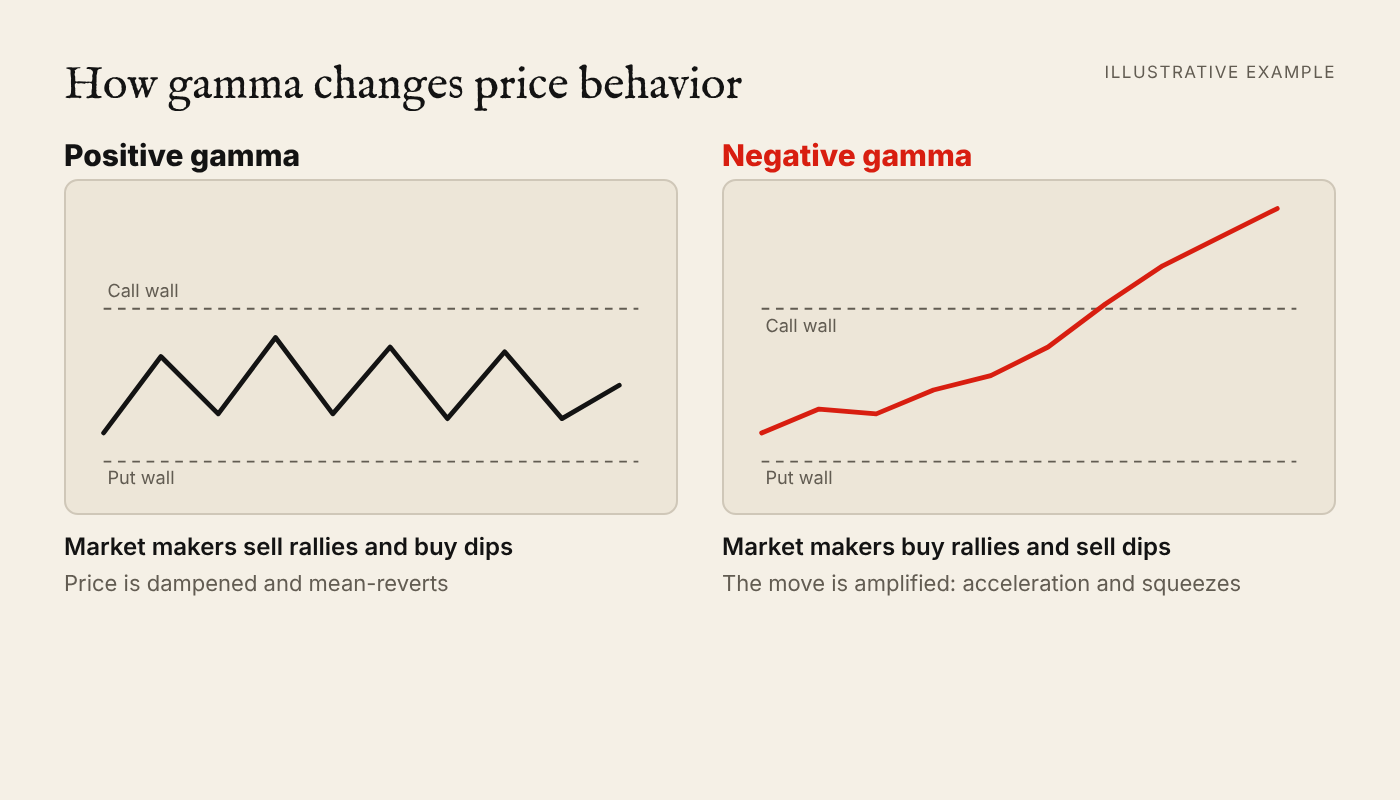
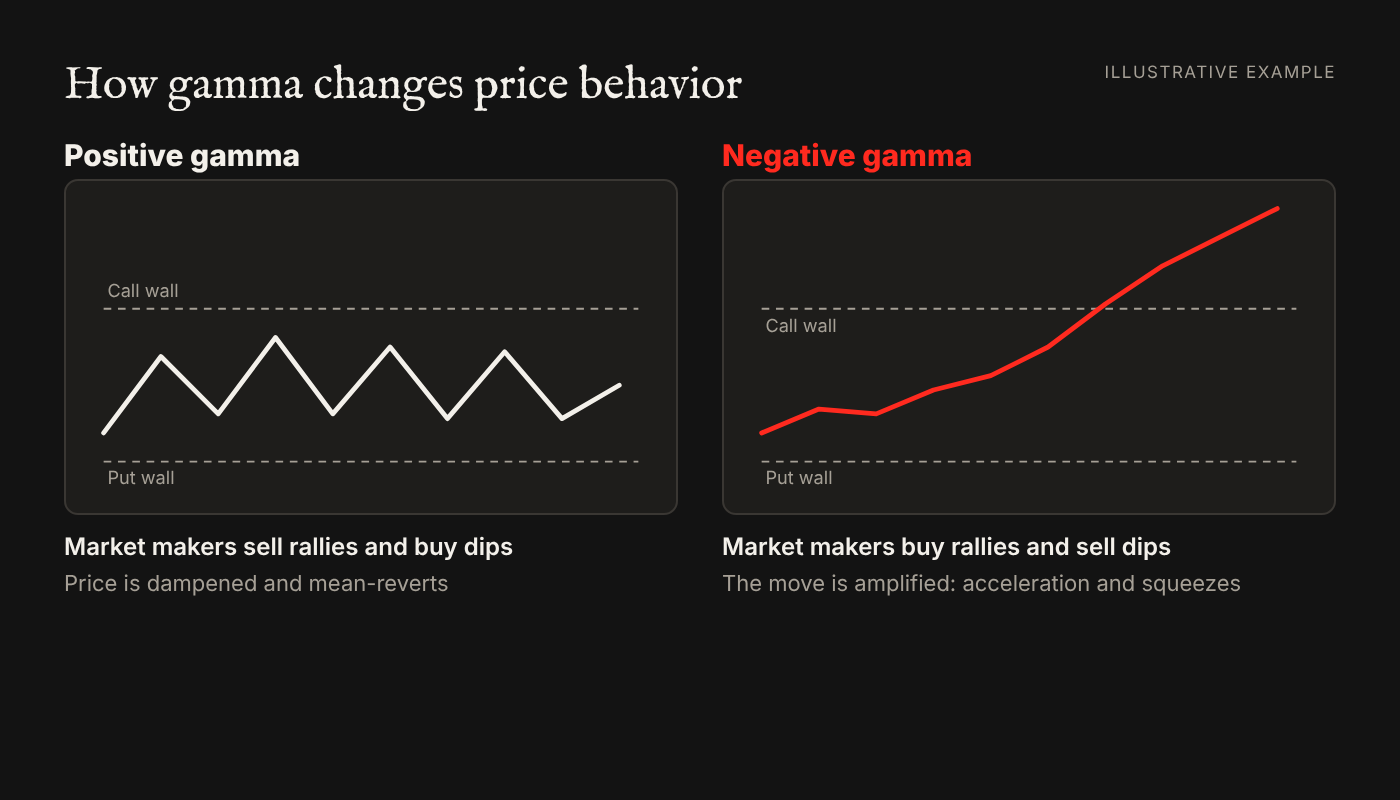
Flow alone is an incomplete signal. Gamma exposure (GEX)* tells you how market makers will have to react. In positive gamma*, they sell rallies and buy dips: the market tends to revert to its mean, and bullish flow often runs into a call wall* that slows price. In negative gamma*, they have to follow the move: acceleration and squeezes become more violent. To review the basics, see our article on options Greeks (delta, gamma, theta, vega).
Dark pools add the dimension of levels. A heavy concentration below price acts as potential support, above it as resistance or a magnet. Aggressive call flow arriving under a solid call wall and a large dark pool level has far less chance of working than the same flow in a negative gamma market with a clear path above.
The method: look for alignment, not the isolated signal
An edge is a statistical advantage: a situation with a more favorable probability, not a certainty. You look for it when several elements point the same way.
- Qualify the order: premium, expiry, strike, ask or above ask*, opening, sweep or block*.
- Identify the intent: speculation, hedge, swing, lotto or gamma positioning.
- Locate the gamma: net GEX positive or negative, price position relative to the call wall and the put wall*.
- Check the dark pools: a significant level below price supports bullish flow, a level above slows it.
- Read the intraday structure: trend, VWAP, momentum, price extension.
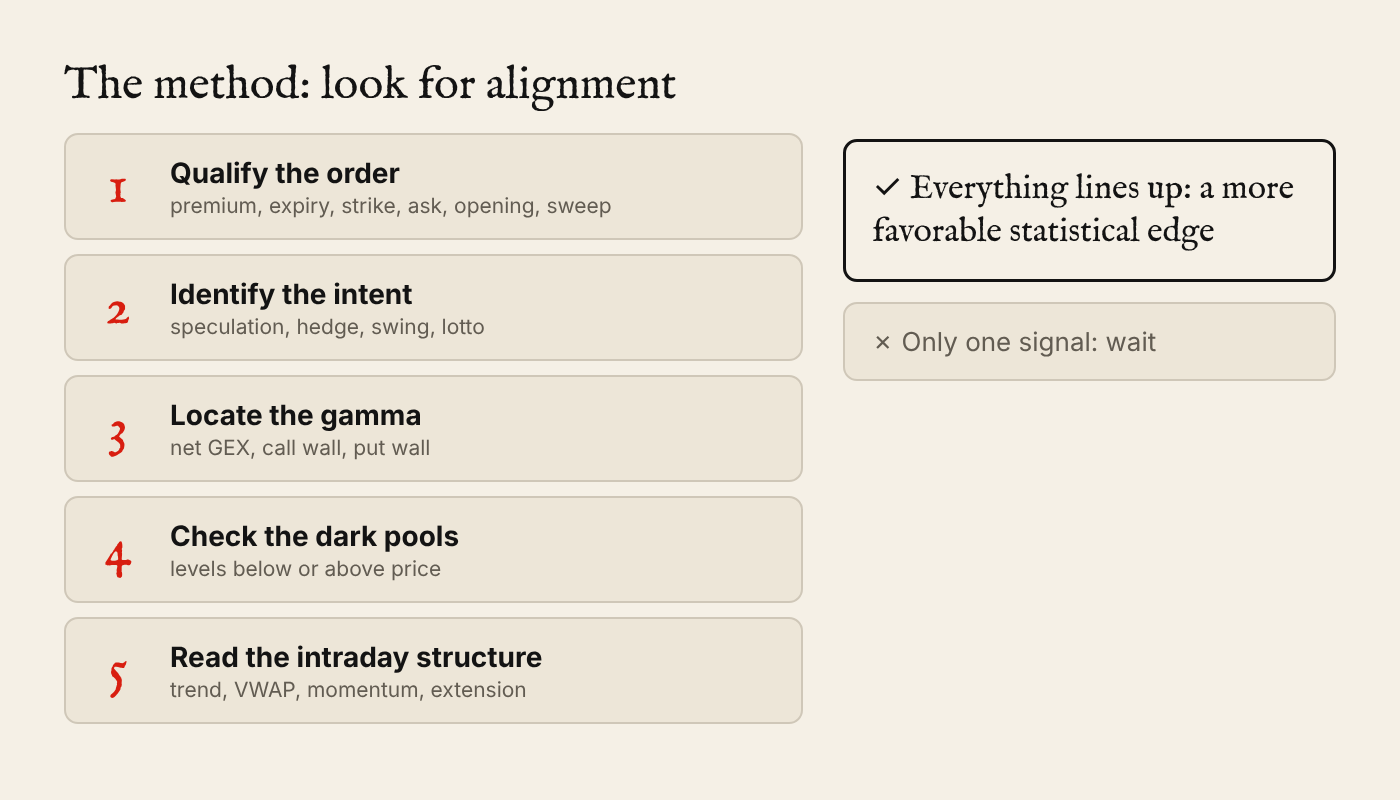
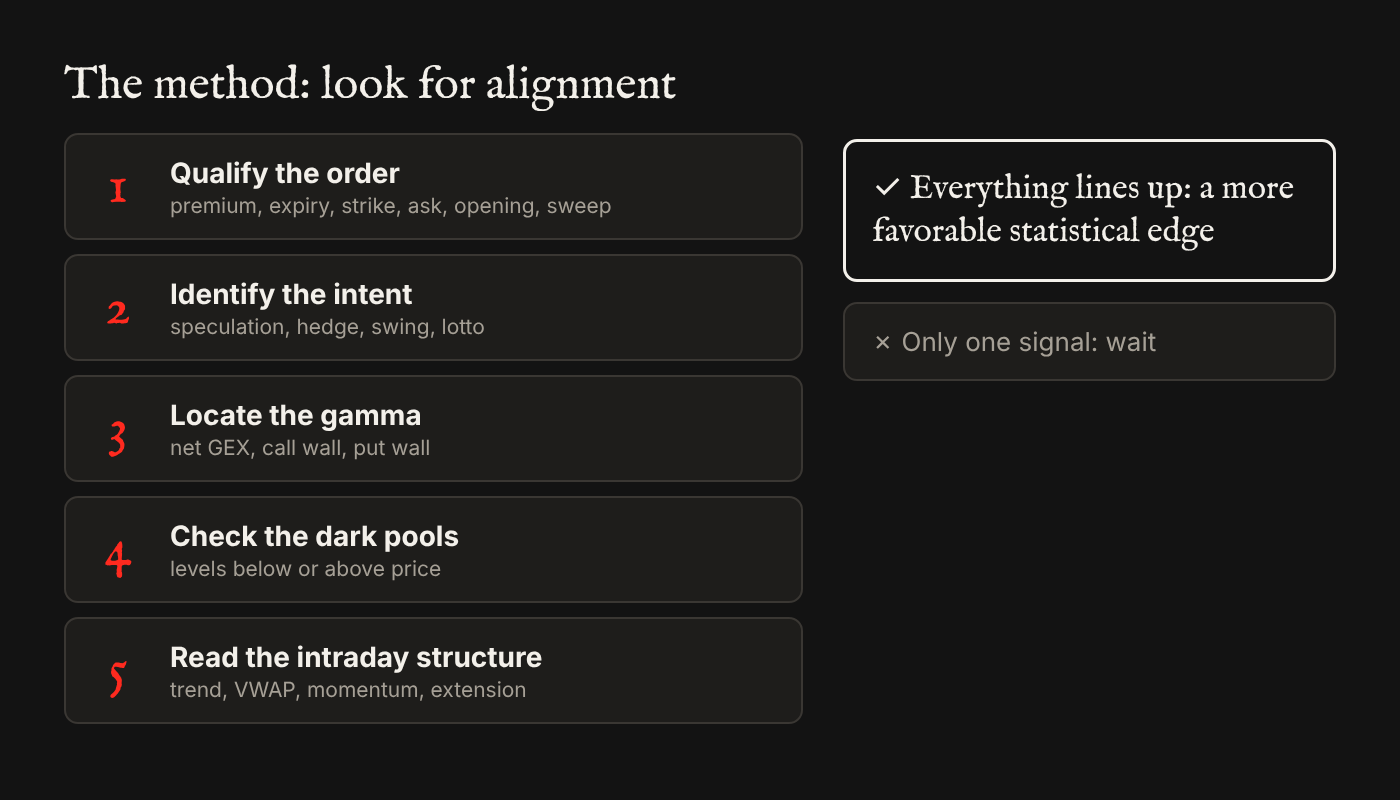
When flow, gamma, dark pool and structure all point the same way, the setup has a more favorable statistical edge. When only one element speaks, it's better to wait.
Even with good alignment, the risks are real: IV crush after an event can empty a premium even when the direction is right, chasing an already extended price (chase) gives a poor risk/reward, a rejection under a call wall can reverse the session, and the flow itself can reverse during the day.
Conclusion
Flow tells you who paid what, rarely why. Before following a spectacular order, ask whether it's a hedge, a lotto or real conviction, then check it against gamma, dark pools and price.
Next week is heavy on volatility with the US elections on November 3: exactly the kind of context where misread flow gets expensive. This article is for educational purposes and is not investment advice; options carry a risk of loss up to the entire premium (see the OCC's official document, "Characteristics and Risks of Standardized Options", PDF).
Definitions
Flow vocabulary, ranked by importance. The ranking is educational: it runs from the criterion that weighs the most to the most contextual. No single criterion is enough on its own.
- Premium*
- Total amount paid in dollars (price × contracts × 100). It is the measure of real conviction: $5M weighs far more than $2,500. Caveat: a large premium can also be a hedge.
- Opening*
- An order that opens a new position (volume above open interest, confirmed the next day). It signals new exposure, not a close. Caveat: often estimated intraday, to be confirmed by open interest.
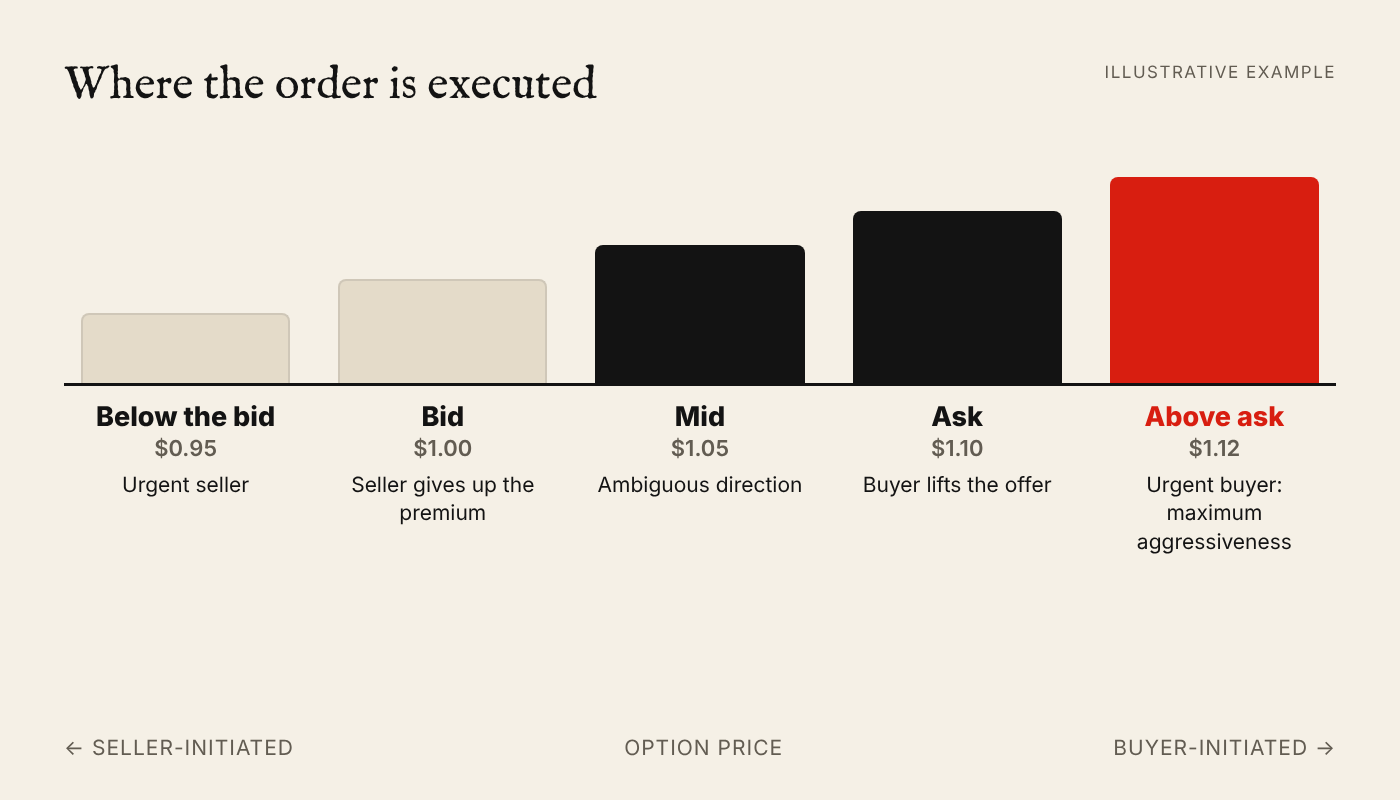
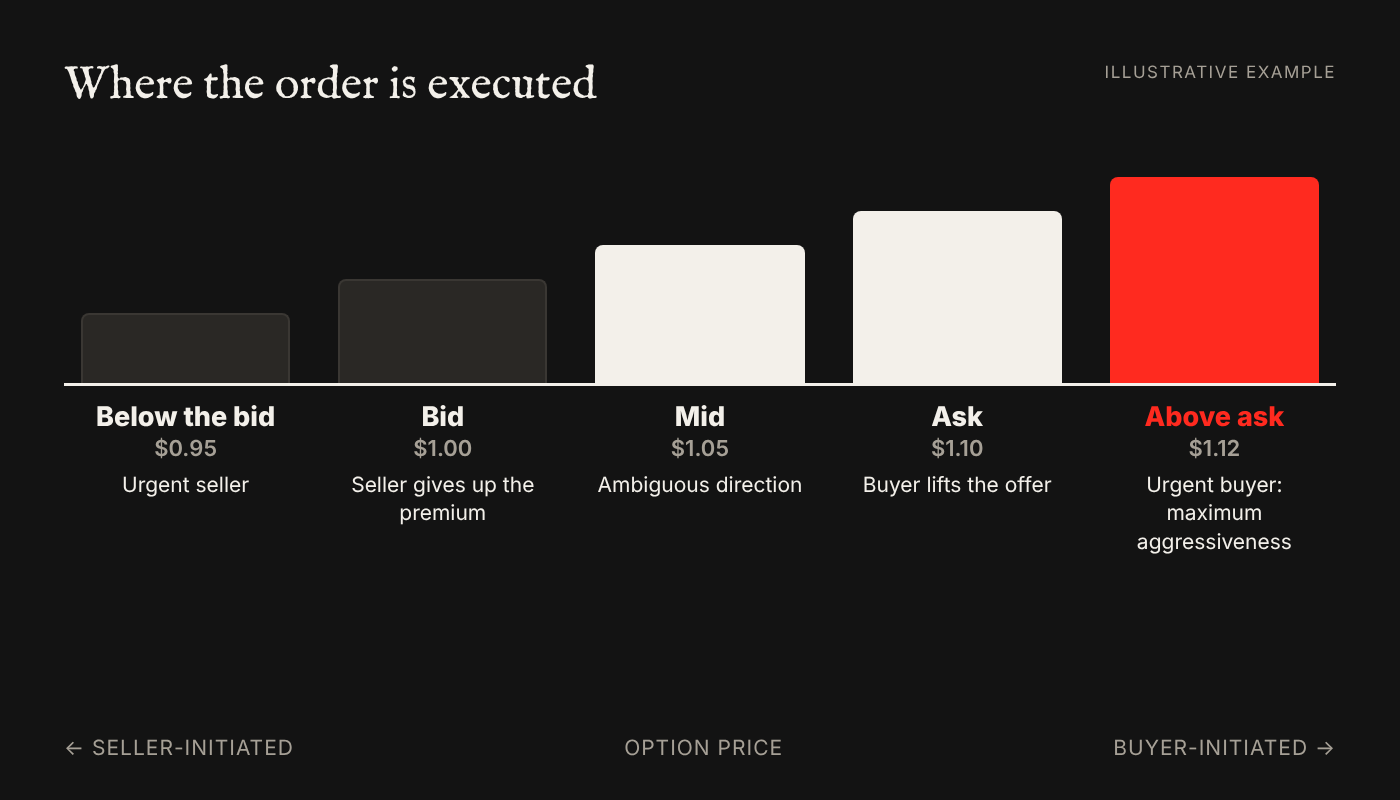
- Above ask*
- An order executed at a price above the best offer. The buyer is in a hurry and willing to pay more: it is the maximum-aggressiveness signal. Caveat: it can come from a fund that has to be filled quickly, with no directional view.
- Ask*
- An order executed at the offer price: the buyer lifts the offer. The order is buyer-initiated, which makes the direction of the bet readable. Caveat: less urgent than an above-ask order.
- Sweep*
- An order split and sent simultaneously to several exchanges to be filled very quickly. It signals urgency: the buyer prioritizes speed over price. Caveat: urgency tells you neither the direction nor the holding period.
- Unusual / Highly unusual
- Volume abnormally high relative to open interest or to the contract's average. Unusual activity worth a closer look. Caveat: a high score can come from an illiquid contract.
- Block*
- A single large order, often negotiated privately (institutional). It signals significant size and a heavyweight player. Caveat: often a hedge or a leg of a spread, so the direction is ambiguous.
- Bid / below the bid
- An order executed at the bid price: the seller gives up the premium. The seller took the initiative: a put at the bid is generally bullish, not bearish. Caveat: easy to read backwards.
Expiry (same-day in 0DTE often reflects short-term or lotto trades, a few weeks a swing or a hedge) and strike (near the money, a conviction trade; far away, a lotto) complete the reading. The more criteria an order stacks from the top of the ranking, the more it looks like aggressive positioning. When the criteria contradict each other, the probability of a reliable signal falls.
Gamma and key levels.
- Gamma exposure (GEX)*
- An estimate of the cumulative gamma exposure of all open options. It shows how many shares market makers must buy or sell to stay neutral when price moves. Net GEX is the difference between the GEX of calls and that of puts. Caveat: it is an estimate, not an exact measure.
- Positive gamma*
- Net GEX is positive. Market makers sell when price rises and buy when it falls, which dampens moves. The market tends to revert to its mean, and supports and resistances are cleaner. Caveat: aggressive bullish flow can run into a call wall.
- Negative gamma*
- Net GEX is negative. Market makers buy when price rises and sell when it falls, which amplifies moves. Acceleration and squeezes are more violent. Caveat: both directions are more dangerous, including for a winning position.
- Call wall*
- The strike where the most calls are concentrated. It is often a resistance, a magnet or a slowdown zone; if it is broken with heavy flow, a gamma squeeze becomes possible. Caveat: it can reject, consolidate or give way, never a given.
- Put wall*
- The strike where the most puts are concentrated. It is a potential support, a defended zone; if it is broken, the decline can accelerate, especially in negative gamma. Caveat: a support is not a guarantee of a bounce.
These levels are estimates: their value depends on the data provider's assumptions about who is the buyer and who is the seller of each option. Read them as probabilities, not as impassable walls.