

Options Greeks Explained: Delta, Gamma, Theta, Vega
When you trade an option, the price on your screen only tells part of the story. What actually drives that price, and how fast it moves, are the options Greeks: delta, gamma, theta and vega. These four indicators are what professional traders check first. They show whether a position is reacting to a move in the underlying, the passage of time, or a shift in implied volatility.
The four options Greeks, explained without a single formula
Delta: the speed
Delta answers one question: if the underlying moves $1, how much does my option move? A call with a 0.50 delta gains about $0.50 when the underlying rises $1. It's the most intuitive Greek: it tells you how closely your option "tracks" the underlying.
Sign: positive for a call, negative for a put.
- A call with a delta of 0.40 gains roughly $0.40 per contract (so $40 on a 100-share lot) when the underlying rises by $1.
- A put with a delta of -0.35 loses roughly $0.35 per contract if the underlying rises by $1, and gains the same amount if it falls by $1.
Delta is also used as a rough probability proxy: a 0.40 delta is often read, loosely, as roughly a 40% chance the option expires in the money. It's a useful approximation, not an exact statistic.
Gamma: the acceleration
Gamma is the delta of delta. It measures how fast delta itself changes as price moves. On a near-the-money 0DTE, gamma is huge: every tick pushes delta up a little faster than the last one. That's what makes at-the-money calls so explosive late in the day, and just as dangerous on the way down.
Sign: always positive, for both calls and puts, as long as the position is long. A short position has negative gamma.
Gamma peaks when an option is at the money. It also mechanically increases as expiration approaches, which is what makes the final hours before expiration so tense. A strike near the price can see its delta jump from 0.20 to 0.80 within minutes.
Theta: the clock working against you
Theta is the cost of time passing. Every minute that goes by shaves a little value off the option, even if price doesn't move a single cent. On a 0DTE, that decay isn't linear: it's nearly invisible in the morning and turns brutal in the final hour. It's the most underestimated Greek, and the one that kills the most positions held too long without a clear direction.
Sign: negative for a long position (long call or long put): time works against the buyer. Positive for a short position, where time works in the seller's favor.
Vega: the market's nerves
Vega measures an option's sensitivity to implied volatility (IV). On a 0DTE, its weight is usually small compared to delta, gamma and theta, but it can make a real difference in the minutes right after a sharp market acceleration, when IV suddenly tightens or jumps.
Sign: positive for a long position (long call or long put): rising IV pushes the option's value up. Negative for a short position.
Vega matters most around scheduled events, such as earnings releases or central bank decisions. IV often climbs beforehand in anticipation, then drops sharply once the uncertainty is resolved. This is known as IV crush, and it can erode an option's value even when the underlying moves in the right direction.
The trade: a QQQ 0DTE call, minute by minute
Scenario context: QQQ is climbing with clean momentum over a few minutes. We enter an at-the-money call (strike 485) at a premium of $1.85. (New to same-day expirations? See our guide on how 0DTE options work.)
| Min. | QQQ | Move | Delta | Δ effect | Γ effect | Θ effect | Vega effect | Premium |
|---|---|---|---|---|---|---|---|---|
| 0 (entry) | 485.00 | — | 0.500 | — | — | — | — | 1.85 |
| 1 | 485.08 | +0.08 | 0.518 | +0.040 | +0.001 | -0.012 | +0.000 | 1.88 |
| 2 | 485.20 | +0.20 | 0.544 | +0.100 | +0.004 | -0.024 | +0.000 | 1.93 |
| 3 | 485.35 | +0.35 | 0.577 | +0.175 | +0.013 | -0.036 | +0.000 | 2.00 |
| 4 | 485.42 | +0.42 | 0.592 | +0.210 | +0.019 | -0.048 | +0.000 | 2.03 |
| 5 | 485.55 | +0.55 | 0.621 | +0.275 | +0.033 | -0.060 | +0.000 | 2.10 |
| 6 | 485.68 | +0.68 | 0.650 | +0.340 | +0.051 | -0.072 | +0.005 | 2.17 |
| 7 | 485.70 | +0.70 | 0.654 | +0.350 | +0.054 | -0.084 | +0.005 | 2.17 |
| 8 | 485.78 | +0.78 | 0.672 | +0.390 | +0.067 | -0.096 | +0.005 | 2.22 |
| 9 | 485.85 | +0.85 | 0.687 | +0.425 | +0.079 | -0.108 | +0.005 | 2.25 |
| 10 (exit) | 485.90 | +0.90 | 0.698 | +0.450 | +0.089 | -0.120 | +0.005 | 2.27 |
How to read this: "effect" is each Greek's contribution to the change in premium since entry (second-order Taylor approximation). The "Delta" column shows how delta itself climbs as the option moves closer to the money, which is gamma working behind the scenes.
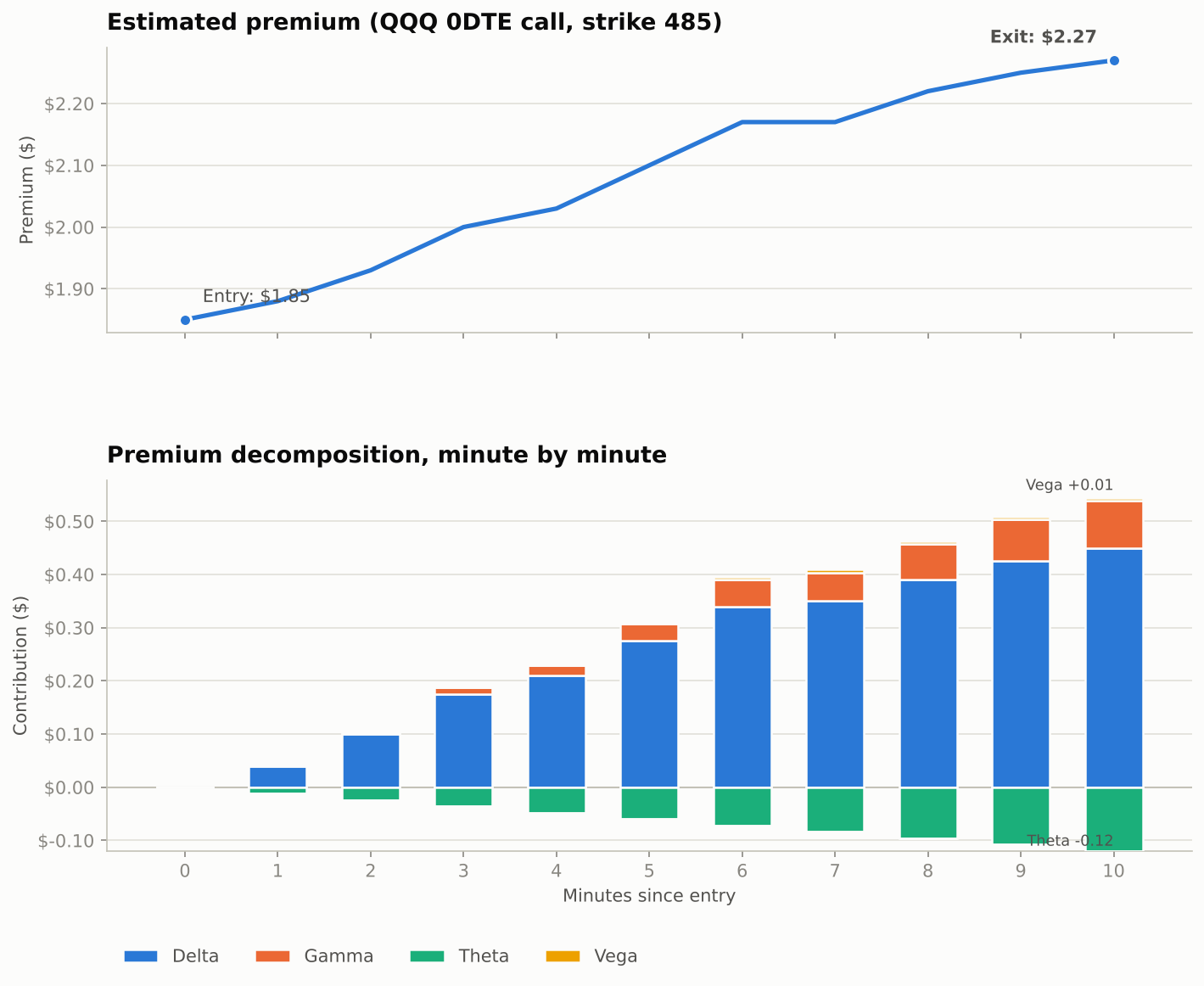
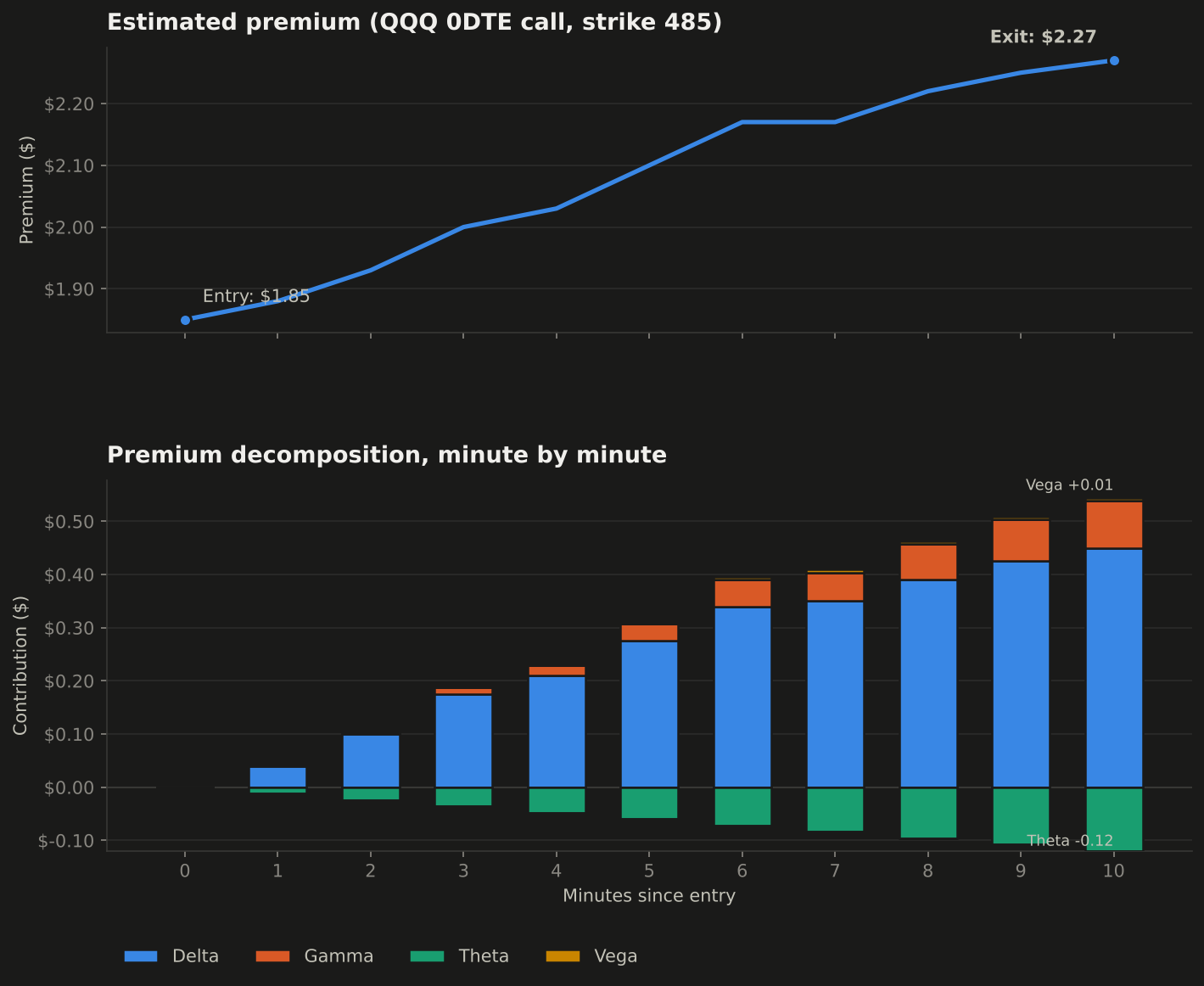
This example is an illustrative, educational simulation; it does not reflect a real quote and should not be read as a trading signal.
What the final breakdown reveals
After 10 minutes, QQQ has only moved +$0.90, a modest move. Yet the call's premium climbs from $1.85 to $2.27, a +22.9% gain. Here's where that comes from, Greek by Greek:
- Delta: +0.45, about 106% of the move. No surprise, it's the main engine: the option tracks the underlying.
- Gamma: +0.09, about 21% of the move. This is the bonus delta alone doesn't explain: because delta itself was rising along with price, each successive tick paid more than the one before it.
- Theta: -0.12, about -28% of the move. Time ate a real chunk of the gain. Without that drag, the premium would have reached $2.39 instead of $2.27.
- Vega: +0.01, barely 1% of the move. A slight IV pop during the acceleration, with no meaningful impact here.
Delta and gamma together explain more than 125% of the premium move; it's theta that eats into the difference. That's exactly the mechanics of a 0DTE: the market has to move faster than time decays, or the position stalls or loses value even while price holds steady.
Options Greeks summary table
| Greek | Measures | Sign (long position) | Watch closely when... |
|---|---|---|---|
| Delta | Sensitivity to the underlying's price | + for a call, − for a put | Estimating gain/loss for a given move |
| Gamma | Rate of change of delta | Always + | The option is near the money and/or near expiration |
| Theta | Value lost to time | Always − | Holding a position for several days, or on 0DTE |
| Vega | Sensitivity to implied volatility | Always + | An event (earnings, central bank) is approaching |
What to take away for your own trading
On a 0DTE, gamma and theta are two sides of the same coin: gamma can blow up your gain if the market accelerates in your favor, but that same gamma, combined with theta, can also melt away a position that stalls. It's no accident that the most profitable intraday moves are the fast ones: the longer a trade drags on, the more theta chips away at what delta and gamma built.
Before entering a 0DTE position, the question worth asking is always the same: if the market doesn't move in the next few minutes, how much does theta alone cost? That number, more than the premium's price itself, is what should dictate position size and how much time to give the trade.
Common mistakes
- Ignoring theta and being surprised to see a position lose value despite a stable underlying.
- Buying options right before an announcement without anticipating the IV crush that can follow, even with the right directional call.
- Underestimating gamma on short-dated expirations, and being caught off guard by how fast delta, and therefore risk, can change within minutes.
- Mistaking delta for an exact probability, when it's only an approximation.
KEY TAKEAWAY
Delta, gamma, theta and vega each measure something different: direction, the speed of that sensitivity, the cost of time, and the effect of volatility. Together, they account for the entire move in the premium.
Conclusion
Delta for direction, gamma for the speed of that sensitivity, theta for the cost of time passing, vega for the impact of implied volatility: together, these options Greeks explain why an option moves the way it does, independent of the price shown on screen.
This content is educational and does not constitute investment advice. Sources: CBOE Greeks documentation, Options Industry Council (OIC), Option Alpha.