

Big Tech Earnings: The Market Wants the AI Bill

Microsoft and Alphabet report Wednesday evening, Amazon and Intel Thursday evening. I do not expect a growth problem: Alphabet’s cloud grew 81.8% last quarter and AWS grew 36.8%. The market has changed its question. After asking whether AI grows revenue, it now asks how much capital it takes to get there, and last week’s drop in Meta is the proof.
What Meta’s drop revealed
On Thursday, October 22, Meta lost nearly 7% (to around $649) after a quarter that beat expectations: $64.6 billion in revenue, up 26% year over year. Capital spending reached $34.9 billion in the quarter alone, the full-year range is $135 to $145 billion, and free cash flow was negative $2.12 billion. The announcement of a non-voting Class C share structure starting in 2027 added questions about how that spending will be financed.
The same day, the Philadelphia Semiconductor Index fell nearly 7% and the Nasdaq had its largest one-day drop in four months. Meta closed Friday around $643, versus roughly $710 before earnings. The market is judging the return on invested capital here, and revenue growth did not protect the stock.
$735 billion of spending in 2026
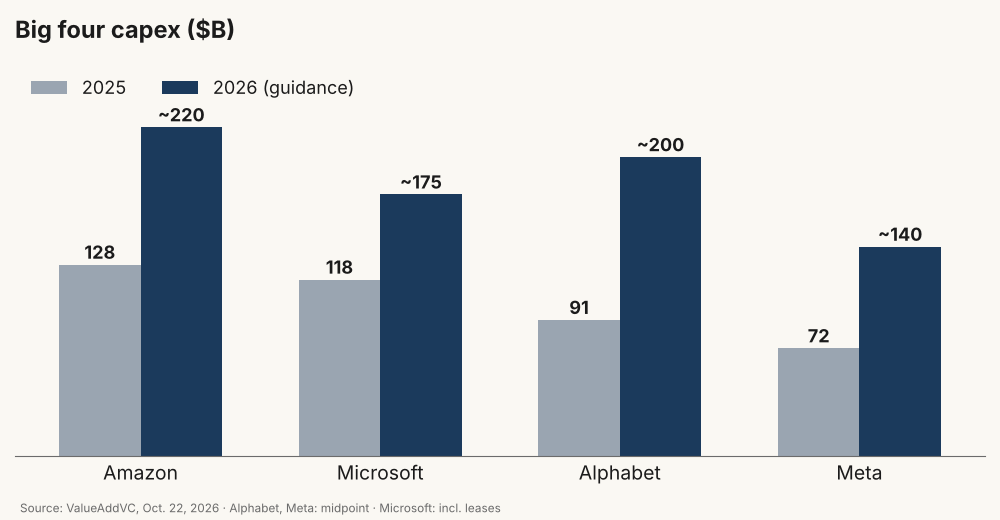
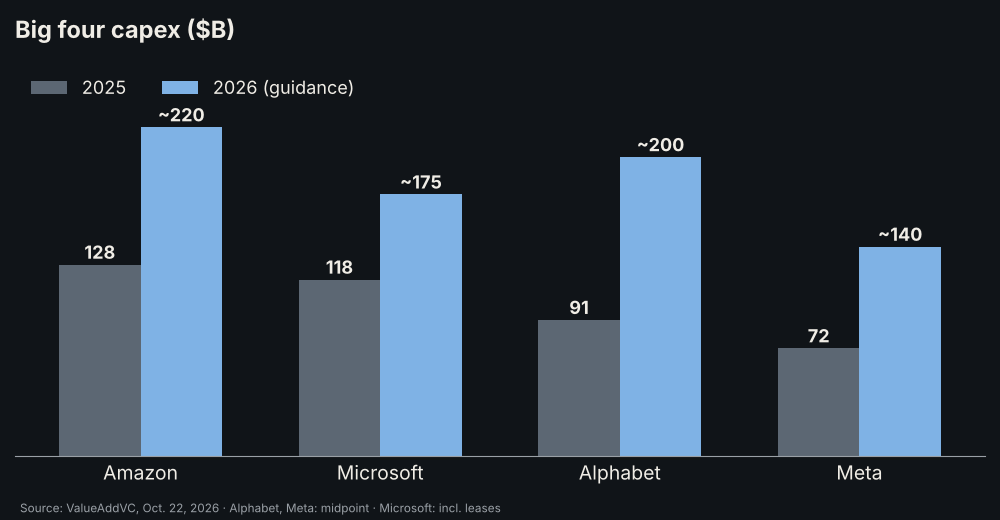
According to a tracker updated on October 22, the big four (Amazon, Microsoft, Alphabet and Meta) plan about $735 billion in capital spending in 2026, versus about $410 billion in 2025, a 79% increase. Amazon is aiming for about $220 billion and Alphabet for $195 to $205 billion. Microsoft cites about $175 billion including finance leases: the decline from April’s $190 billion comes from a change in lease accounting, with no cut to the plan. Alphabet also expects a significant increase in 2027, and its spending exceeded its operating cash flow last quarter. Other estimates that include more players put the total above $800 billion.
What I will watch on Wednesday and Thursday
First question: 2027 capex. If Alphabet, Microsoft or Amazon raise their ranges again, the market will have to choose between rewarding demand and punishing spending, and Meta suggests the second reaction. Second question: free cash flow, where Alphabet is the most exposed. Third question: proof of demand. According to Andy Jassy, AWS capacity is largely sold out through 2027. Azure has met or beaten the top of its guidance in seven of the last eight quarters, and targets about 45% in constant currency this quarter. Google Cloud posted a 35.6% operating margin.
My sense: Amazon and Microsoft have more visible proof of demand than Meta, which has no cloud business to rent out its capacity. I therefore expect a milder penalty if they raise spending while showing a backlog. That is a probability, not a certainty, and a weak reaction remains possible even with good numbers.
Expectations and implied moves
| Company | Report | Expected EPS / revenue | 2026 capex | Implied move | Average of last 8 |
|---|---|---|---|---|---|
| Microsoft | Wednesday 28, after the close | $4.71 / $90.6B | about $175B (incl. leases) | 4.2% | 7.0% |
| Alphabet | Wednesday 28, after the close | about $3.00 / $127.9B | $195B to $205B | 5.3% | 4.1% |
| Amazon | Thursday 29, after the close | $1.96 / $202.2B | about $220B | 7.3% | 6.2% |
| Intel | Thursday 29, after the close | $0.40 / N/A | N/A | 8.8% | 9.3% |
Microsoft is the only one of the four whose implied move sits clearly below the average of its last eight reports. Alphabet is the reverse. Simplifying, if Microsoft returns to its usual amplitude, the straddle buyer has the edge, and if Alphabet stays under its implied move, the seller does.
What this means for my options
On Wednesday, the Fed speaks at 2:00 p.m. New York time, and Microsoft and Alphabet report after the close: the day’s uncertainty stacks up. Implied volatility on the stocks involved stays elevated until the release, then collapses at Thursday’s open. For Thursday’s 0DTE on QQQ, Microsoft, Alphabet and Amazon carry heavy weight in the index: the opening gap from Wednesday evening sets the scene, and Amazon’s results after the close add gap risk for Friday.
I prefer to wait for the open to judge the real reaction instead of betting on the release, and I limit my single-stock positions to risk defined in advance. This is my view as a trader, not an investment recommendation. The figures in this article are as of October 26, 2026.
Sources
- SentiSense : Big Tech earnings this week, Microsoft, Alphabet and Amazon report on October 28 and 29, 2026
- ValueAddVC : Big Tech AI spending 2026, capex company by company
- AI Investing Watch : week of October 25, 2026
- Gotrade : Week ahead, Fed decision, US GDP and Big Tech earnings
- BabyPips : Fundies cheat sheet, Oct 26 to 30, 2026